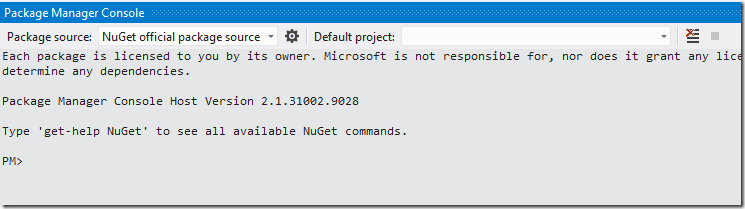
The NuGet Package Manager Console is built into Visual Studio on Windows version 2012 and later. It is not included with Visual Studio for Mac or Visual Studio Code.
Download and Installation
Try our On-Premise APIs to load, render and display VSX documents on.NET Framework,.NET Core, Mono or COM Interop. Open NuGet package manager, search for Aspose.Diagram.the Package Manager Console.
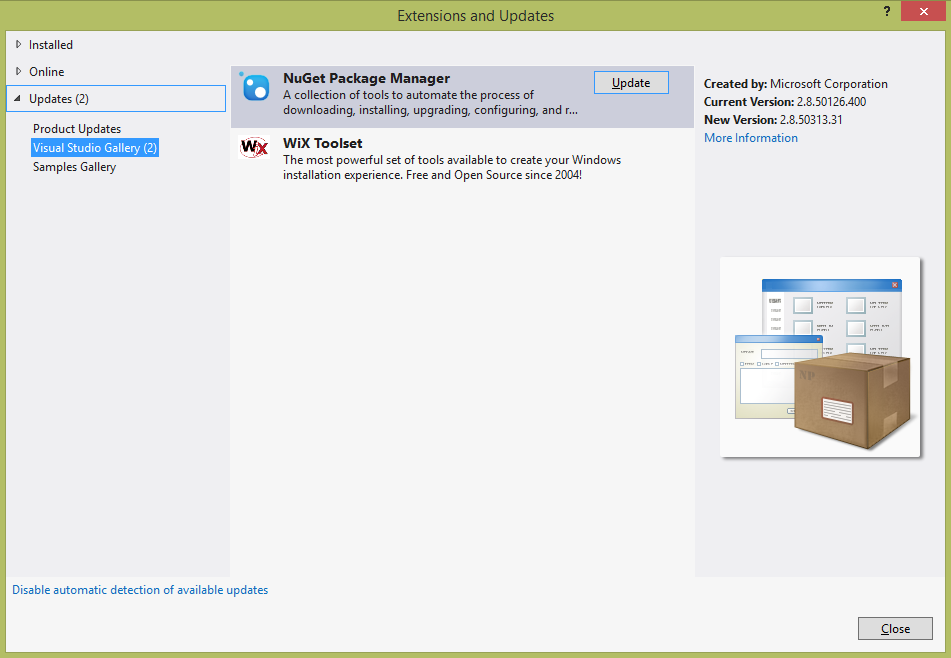
By now most people know that the Package Manager Console that comes with NuGet is PowerShell embedded inside of Visual Studio. It is based on its PowerConsole predecessor which was the first (that I'm aware of) to embed PowerShell inside of Visual Studio and give access to the Visual Studio automation DTE object. Then download the latest NuGet Package Manager for Visual Studio 2015 like Carlos said to re-install it. For VS 2017, you can try to re-run the VS 2017 installer as administrator, click the icon besides ‘Modify’ and ‘Launch’ and choose ‘Repair’ to repair it.
In Visual Studio 2017, NuGet and the NuGet Package Manager are automatically installed when you select any .NET-related workloads; you can also install it individually by checking the Individual components > Code tools > NuGet package manager option in the Visual Studio 2017 installer.
- You can use NuGet PowerShell commands to find, install, uninstall, and update NuGet packages.
- To open the console in Visual Studio, go to the main menu and select Tools > NuGet Package Manager > Package Manager Console command.
By default, console commands operate against a specific package source and project as set in the control at the top of the window.
Install Package
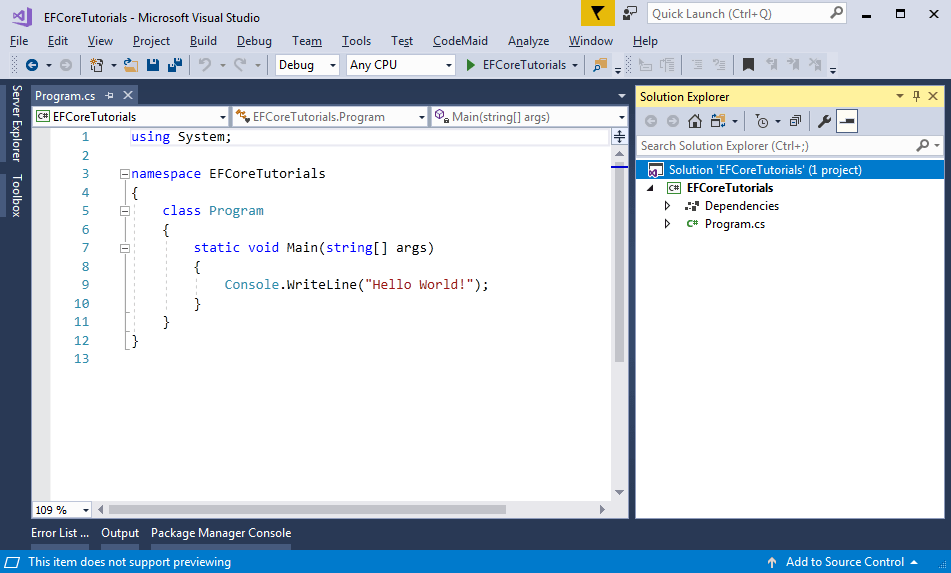
To install a package, use Install-Package command.
Examples
The following command adds the Z.EntityFramework.Classic package to the default project as specified in the console's project selector.
The following command adds the Z.EntityFramework.Classic package to a project named EFDemo that is not the default
When you install a package, it performs the following actions.
- The console displays applicable license terms in its window with an implied agreement.
- If you do not agree to the terms, you should uninstall the package immediately.
- A reference to the package is added to the project file and appears in Solution Explorer under the References node.
Uninstall Package
To uninstall a package, use Uninstall-Package command.
Examples
The following command uninstalls the Elmah package from the default project.
The following command uninstalls the Elmah package and all its unused dependencies.
The following command uninstalls the Elmah package even if another package depends on it.
When you uninstall a package, it performs the following actions.
- Removes references to the package from the project and references no longer appear in Solution Explorer.
- Reverses any changes made to app.config or web.config when the package was installed.
- Removes previously-installed dependencies if no remaining packages use those dependencies.
Date Published: 19 January 2017
Visual Studio Package Manager Console Add-migration
Occasionally I run into an issue where I’ll open a solution in Visual Studio, build it, and the build will fail because of dependent packages. I’ll try every way offered by Visual Studio to restore packages, but it will claim everything is up to date. Looking in Solution Explorer, you’ll see that some packages are clearly missing (icons on the packages showing they’re not there), but no amount of telling VS to restore packages (or building, which should do the restore as well) will get them.
Visual Studio Package Manager Console Restore
The fix for this is to open Package Manager Console and run this command:
Update-Package -reinstall
Note: If you just run Update-Package, it will try to update all packages to the latest version, which isn’t necessarily what you want (especially if you’ve simply pulled from source control and want the project to just build with the versions of packages it has in source control).
That’s it – this does the trick for me. If you want to narrow it down to a certain project, just make sure you’ve selected the correct active project, or use this:
Update-Package -reinstall -Project ProjectName
I’ve seen this problem frequently on Visual Studio 2015 and a .NET 4.6 solution with a handful of projects (ASP.NET and class libraries). I’m not sure how widespread it is, or if it’s still present in VS2017. Hope this helps.
Visual Studio Package Manager Console Disabled
Category - Browse all categories
Software Architect
Steve is an experienced software architect and trainer, focusing on code quality and Domain-Driven Design with .NET.