Freecell Solitaire is a full screen classic solitaire card game. Just like in kondike solitaire, build stacks of cards in descending order and opposite color (red or black). You can drag-and-drop any card into one of the four 'free' cells on the top left, but always try to have an exit-strategy for that card.
One of the world's most popular Solitaire games, Freecell is a remarkable combination of strategy and simplicity. Nearly all games can be solved, but with only four open cells (and only ten minutes on the timer), can you beat the clock and win the game? There are three areas on the game board: the cells (upper left), the foundations (upper. State-of-the-art cell craft game. Germs and hygiene game. Germ Microbe Hunter Game. Teaching Children about Germ Game. Bacteria Germinater Game. Virtual reality cell Explorer game. The Virtual Cell. Cells are the starting point. Cell to Singularity is an idle game in which you start as a single cell organism, and upgrade your biology, intellect, and technology until. You engulf an entire planet with a civilization on the brink of technological singularity. Cell to Singularity - Evolution Never Ends on Steam.
Beat free cell solitaire by getting all 52 cards into the four suit-oriented foundations in the top-right.
FreeCell is a fun and challenging skill game. This card game is one that can be won almost every time, if you've got the right moves!
Based on Solitaire, FreeCell is a card game played withe one deck of cards. FreeCell has eight tableau piles, four foundations piles, and four open cells. The four foundations are used to place cards, by suits, from Ace to King. The four open cells can be used to place extra cards. Cards may be moved in and out of these free cells.
FreeCell tableau piles are built downwards by alternating colors. You may only move a pile around the board containing 5 or less cards. This is because the cards below the top card are 'placed' in the free cells in order to move them. They will not physically be moved, but there must be space available for the pile move to occur.
Place all the cards into the four foundation piles by suit from Ace to King and you are victorious! FreeCell can be enjoyed by all and this version will keep you running back for more. Challenge yourself to a game of FreeCell every day to keep your mind sharp as a tack!
- Build tableau piles down by alternating colors
- Place all freecell cards into the foundation piles to win
- For every open space (free cell or empty column), you may move 1 additional card
- Virtually every free cell game can be won--so work on your skills!
DISCLAIMER: The games on this website are using PLAY (fake) money. No payouts will be awarded, there are no 'winnings', as all games represented by 247 Games LLC are free to play. Play strictly for fun.
- About
- Teachers
- Administrators
- Parents
- Learn
In this series of games, your students will learn about the different organelles in the cell and the functions they perform. The Parts of the Cell learning objective — based on NGSS and state standards — delivers improved student engagement and academic performance in your classroom, as demonstrated by research.
Scroll down for a preview of this learning objective’s games and the concepts they drive home.
Concepts Covered
Cells contain specialized structures, called organelles, that perform specific functions. Prokaryotic cells, like bacteria, do not have many organelles, while eukaryotic cells have defined organelles. All cells have a semi-permeable cell membrane that lets them absorb nutrients and get rid of waste.
Cell Games Saga
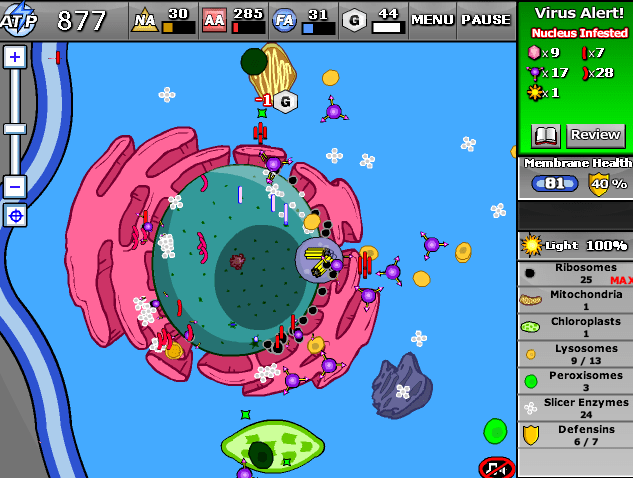
The nucleus is an organelle that contains the cell’s genetic information, DNA. It serves as the command center of the cell.
Mitochondria generate the energy the cell needs to perform its functions. They are commonly known as the “powerhouse” of the cell.
Ribosomes create proteins necessary for the cell to function. They float through the cytoplasm or are attached to the rough endoplasmic reticulum (ER).
The rough ER, with ribosomes attached to it, is the site of protein synthesis. The smooth ER makes hormones and stores and synthesizes lipids.
The Golgi apparatus packages substances like proteins that are needed elsewhere in the cell or in the body and sends them there.
Lysosomes contain enzymes that help the cell’s digestive processes.
A preview of each game in the learning objective is found below.
Cell Games Across The Multiverse
You can access all of the games on Legends of Learning for free, forever, with a teacher account. A free teacher account also allows you to create playlists of games and assignments for students and track class progress. Sign up for free today!