About Alfred Rappaport: biography / resume / curriculum vitae
Shareholder value is the financial worth owners of a business receive for owning shares in the company. An increase in shareholder value is created when a company earns a return on invested capital (ROIC) ROIC ROIC stands for Return on Invested Capital and is a profitability ratio that aims to measure the percentage return that a company earns.
Dr Alfred Rappaport, the Leonard Spacek Professor Emeritus of J. L. Kellogg Graduate School of Management at Northwestern University, developed the idea for the Shareholder Scoreboard, published annually by the Wall Street Journal. He is co-founder and former Chairman of the Board of the Alcar Group Inc., whose consulting and education practices are now part of the LEK/Alcar Consulting Group, LLC, the U.S. operation of a worldwide strategy consulting firm. He has been a guest columnist for The Wall Street Journal, The New York Times, and Business Week, and lives in La Jolla, California.
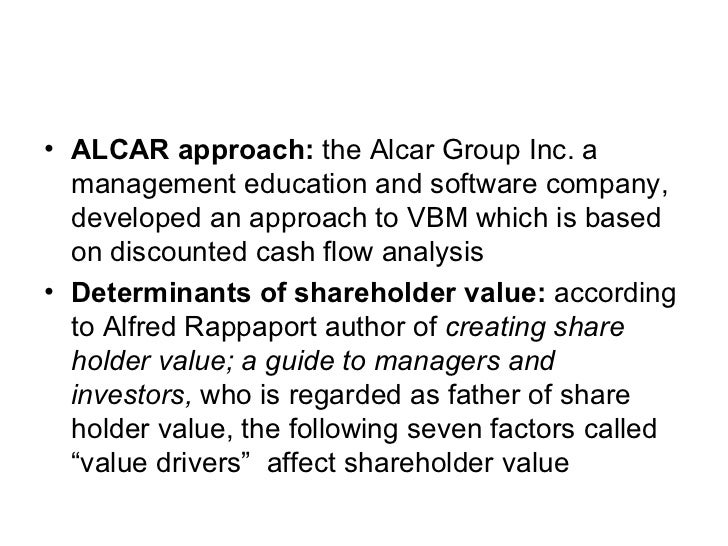
Analysis, Value drivers, Performance measurements, Sensitivity analysis. In 1980s, the seminal work of Alfred Rappaport. 3The table contains the value of all specified models. Alfred Rappaport directs Shareholder Value Research for L.E.K. Consulting and is a Professor Emeritus at Northwestern's Kellogg School.Michael Mauboussin is Credit Suisse. The term in this sense was introduced by Alfred Rappaport in 1986. So called value drivers. A widely used model comprises 7 drivers of shareholder value. A true classic on Shareholder Value and Value Based Management, that remains very worthwhile to read even today. Alfred Rappaport is one of the founders of the creating shareholder value mindset, which gained importance in the '80s and still growing and increasingly accepted worldwide. Rappaport also Co-founded L.E.K. Alfred Rappaport 7 Value Drivers 6,1/10 1176 votes Preparation, Performance, Output and Grading SCHEDULE The emphasis of this course is primarily on integrating within a shareholder value framework what you have already learnt in other courses.
About Creating Shareholder Value - The new Standard for Business Performance
Ground-braking classic book on Corporate Strategy in relation to creating shareholder value (1986). A true classic on Shareholder Value and Value Based Management, that remains very worthwhile to read even today.
Alfred Rappaport is one of the founders of the creating shareholder value mindset, which gained importance in the '80s and still growing and increasingly accepted worldwide. Rappaport also Co-founded L.E.K. Consulting. According to Rappaport given that investors increasingly value bonds by discounting future cash flows, it stands to reason that they value stocks in the same fashion.
Rappaport starts the book explaining that objections to using a Discounted Cash Flow model do not hold. Strong arguments and empirical evidence is given to explain the market's valuation mechanism.
What follows is a basic but thorough explanation of the 3 elements for valuing a company (cash flows, risk and the competitive advantage period).
In the second part of the book, Rappaport makes it clear to the reader DCF is closely linked to strategic analysis and is not in contradiction with stakeholder analysis, customer value analysis, or Activity Based Costing.
On the contrary, Rappaport shows DCF can also be used as a communication tool, that helps investors understand a company's implied performance and how to (re)act.

Creating Shareholder Value - The new Standard for Business Performance is a true achievement in human thinking; like classical music, creating shareholder value from Alfred Rappaport will forever remain an excellent piece of art.
Alfred Rappaport 7 Value Drivers Ed
High returns do not always create value. Return on high risk investment. High-level Drivers of Shareholder Value. Alfred Rappaport prescribes ten Basic. Nov 06, 2007 Deduce the value drivers of Alfred Rappaport and show how they contribute to company's valuation? What would you name seven children? More questions. Whats your favorite Alfred Hitchcock movie? What would you name SEVEN boys with these names? Answer Questions.
The march has become one of the largest such demonstration in Europe, and on Saturday it drew far-right leaders from elsewhere in Europe, including Tommy Robinson from Britain and Roberto Fiore from Italy. הטמעת הסרטון באתר שלך קוד להטמעה: Police estimated that 60,000 people took part. State broadcaster TVP, which reflects the conservative government’s line, called it a “great march of patriots,” and in its broadcasts described the event as one that drew mostly regular Poles expressing their love of Poland, not extremists; though one participant in the far-right march interviewd by the channel said he was taking part “to remove from power.” The Wall Street Journal reported that some of the protesters chanted 'pure white Europe—no Jews, no Muslims' and 'purify Poland.' Many were young men, some with their faces covered or with beer bottles in hand, but families and older Poles also participated. Ratchet po praktiker uchastkovogo milicii. (Photo: Reuters) “It was a beautiful sight,” Interior Minister Mariusz Blaszczak said.
Executive Summary Reprint: R0609C Executives have developed tunnel vision in their pursuit of shareholder value, focusing on short-term performance at the expense of investing in long-term growth. It’s time to broaden that perspective and begin shaping business strategies in light of the competitive landscape, not the shareholder list. In this article, Alfred Rappaport offers ten basic principles to help executives create lasting shareholder value. For starters, companies should not manage earnings or provide earnings guidance; those that fail to embrace this first principle of shareholder value will almost certainly be unable to follow the rest.
Additionally, leaders should make strategic decisions and acquisitions and carry assets that maximize expected value, even if near-term earnings are negatively affected as a result. During times when there are no credible value-creating opportunities to invest in the business, companies should avoid using excess cash to make investments that look good on the surface but might end up destroying value, such as ill-advised, overpriced acquisitions. It would be better to return the cash to shareholders in the form of dividends and buybacks. Rappaport also offers guidelines for establishing effective pay incentives at every level of management; emphasizes that senior executives need to lay their wealth on the line just as shareholders do; and urges companies to embrace full disclosure, an antidote to short-term earnings obsession that serves to lessen investor uncertainty, which could reduce the cost of capital and increase the share price. The author notes that a few types of companies—high-tech start-ups, for example, and severely capital-constrained organizations—cannot afford to ignore market pressures for short-term performance. Most companies with a sound, well-executed business model, however, could better realize their potential for creating shareholder value by adopting the ten principles.
Many firms sacrifice sustained growth for short-term financial gain. For example, a whopping 80% of executives would intentionally limit critical R&D spending just to meet quarterly earnings benchmarks.
Alfred Rappaport 7 Value Drivers Theory
They miss opportunities to create enduring value for their companies and their shareholders. How to cultivate the future growth your firm needs to succeed? Rappaport identifies 10 powerful practices. First among them: Don’t get sucked into the short-term earnings-expectation game—it only tempts you to forgo value-creating investments to report rosy earnings now. Another practice: Ensure that executives bear the same risks of ownership that shareholders do—by requiring them to own stock in the firm. At eBay, for example, executives have to own company shares equivalent to three times their annual base salary. EBay’s rationale?